CALL US! 415-851-9190
LetsGo@Lucky-Tuk-Tuk.com

Explore the stories of tall ships, working tugboats and ferries that built the Bay Area—with an up-to-date guide to what you can visit while Hyde Street Pier is being rebuilt.
Explore Private Lucky Tuk Tuk ToursWhat’s Open in 2026?
Hyde Street Pier
Closed during its long-term rebuild
Maritime Museum
Free · Wednesday–Sunday
Historic Fleet
At Mare Island · limited weekend tours
A waterfront time capsule of tall ships, tugboats and old-school San Francisco. If you love history you can almost reach out and touch—or just a beautiful, breezy place to explore near Fisherman’s Wharf—this maritime park deserves a spot on your itinerary.
The San Francisco Maritime National Historical Park connects the ships that carried cargo across oceans, the ferries that transported Bay Area commuters and the people who built the city’s seafaring identity. Its landmarks include the Aquatic Park Historic District, the Maritime Museum in a remarkable Art Deco-era bathhouse, the Visitor Center at Hyde and Jefferson streets, a major maritime research collection and the famous Hyde Street Pier fleet.
There is one important 2026 wrinkle: Hyde Street Pier is closed for a long-term reconstruction project, and its historic ships have relocated to Mare Island in Vallejo. The waterfront is still worth exploring, however—and the museum and visitor center offer plenty of maritime history right in San Francisco. A private Lucky Tuk Tuk city tour can introduce the historic waterfront and neighboring attractions, with photo stops where access and traffic permit. Ship tours, when offered at Mare Island, require a separate visit.
As of November 2026, the park remains open in several locations, but Hyde Street Pier itself is closed. The National Park Service is protecting its aging historic fleet while planning and rebuilding the waterfront facilities. Instead of heading to the pier expecting to board ships, use the following current guide.
Important distinction: Mare Island is in Vallejo, not at Fisherman’s Wharf. A San Francisco sightseeing ride does not include transportation to Mare Island or admission to the historic ships. Because some older NPS pages still say all boarding is prohibited, treat the park’s current hours and access page and alerts as your final checks.

San Francisco grew up around its harbor. Long before bridges, freeways and container terminals, sailing ships connected the Bay to California gold fields, Pacific Coast forests, Alaska fisheries and ports around the world. The region’s maritime past is not a single story: it includes Indigenous use of the bay, oceanic trade, Chinese and other immigrant labor, shipbuilding, waterfront unions, commercial fishing, ferry passengers, and the mechanical revolution that gradually replaced sail with steam and diesel power.
During the Gold Rush, vessels arrived with supplies and passengers, and the city’s wharves quickly expanded. Some ships were even abandoned as their crews rushed inland to seek fortune. Later, cargo schooners delivered lumber that built California towns, while passenger ferries connected communities that did not yet have convenient roads or bridges. Harbor tugs performed unglamorous but essential work, maneuvering heavy vessels through busy and sometimes hazardous waters.
Hyde Street Pier served as a ferry terminal during the era when automobiles and passengers crossed the bay by boat. The opening of the Bay Bridge in 1936 and Golden Gate Bridge in 1937 profoundly reshaped regional transport. The pier eventually found a second life as a berth and exhibition setting for preserved historic vessels. California authorized restoration work, and the Maritime State Historical Park opened in 1963. The ships transferred into the federal park system in the late 1970s, and San Francisco Maritime National Historical Park was established in 1988.
Nearby Aquatic Park represents another chapter of waterfront history. Built during the New Deal era, its bathhouse opened in 1939 as a public recreation building. Its sleek, rounded Streamline Moderne style deliberately resembles an ocean liner. Today the structure houses the Maritime Museum, whose artwork, exhibits and waterfront setting connect the architecture of recreation to the working history of San Francisco Bay.
The Maritime Research Center safeguards photographs, maps, journals, ship plans and artifacts that allow historians and families to investigate West Coast seafaring life in detail. That documentary work matters as much as the vessels: without records, there would be far fewer clues about the people who worked aboard them.
1939
Aquatic Park Bathhouse opens
1963
Maritime State Historical Park opens
1988
National historical park established
The park’s preservation mission continues today, most visibly through the temporary fleet move and Hyde Street Pier replacement project. These changes are inconvenient for visitors, but essential to keeping irreplaceable vessels intact for generations to come.
The 1886 square-rigger Balclutha sailed around the stormy southern tip of South America 17 times during a globe-spanning working career.
The 1939 Aquatic Park Bathhouse uses Streamline Moderne architecture to evoke a passenger liner, right down to its sweeping horizontal curves.
The sidewheel tug Eppleton Hall made an extraordinary voyage from Britain to California via the Atlantic and Panama Canal.
The huge wooden Eureka reminds visitors that ferryboats once carried passengers, horses and later cars across the Bay.
The schooner C.A. Thayer once hauled timber along the Pacific Coast, a job central to expanding towns and cities.
The shallow-draft Alma carried goods on San Francisco Bay and the Sacramento–San Joaquin Delta waterways.
The 1907 tug Hercules was built for demanding ocean towing, showing the industrial side of maritime history.
The federal national historical park was created in 1988, although the preserved ship collection and predecessor maritime park are older.
The bathhouse contains original maritime murals and mosaic artworks, making it as much an art stop as a history museum.
The research center holds records and collections that reveal the lives of crew members, shipbuilders and communities linked to the sea.
Hyde Street Pier first served practical cross-bay travel long before it became known for historical ship exhibits.
During the pier reconstruction the fleet has been moved to Mare Island, Vallejo, where limited weekend ship tours depend on staffing.
If your visit is confined to San Francisco and you cannot travel to Mare Island, the Maritime Museum at 900 Beach Street is the best indoor stop. The bathhouse building is striking on its own, with rounded ship-like forms, flowing horizontal design and a setting overlooking Aquatic Park Cove. The 1930s designers made a public building feel like a transatlantic ocean liner—one of the city’s most delightfully theatrical pieces of waterfront architecture.
Inside, visitors can enjoy exhibits relating to West Coast maritime trade and an unusual artistic surprise: original murals and mosaic work depicting imaginative undersea scenes. A small film explains the building’s history. Head to the veranda when accessible for a striking perspective across the protected cove toward the Bay.
When to visit: Wednesday through Sunday, 10 AM–4 PM; admission is free. Check holidays, special programming and any temporary closures on the official Maritime Museum page.
At 499 Jefferson Street, close to the Hyde Street cable car turnaround, the Maritime Visitor Center introduces the wider history of the waterfront with exhibits, a park film and visitor information. It is generally open 10 AM–5 PM daily except designated holidays. This is the right place to ask what tours, talks or preservation-related programs are currently offered—and which parts of the park are accessible that day.
The museum and visitor center are separate buildings. If your day is short, pair one of them with a leisurely walk around Aquatic Park, rather than assuming the closed pier can be added to the same route.

The historic vessels are the heart of this attraction. Six major vessels are listed on the NPS’s current historic-fleet overview: Balclutha, C.A. Thayer, Eureka, Alma, Hercules and Eppleton Hall. The original Lucky Tuk Tuk page also described a San Francisco Bay ark, a historic houseboat type exhibited in the pier setting; we have retained that seventh story separately so the original material is not lost. It is not a seventh member of the six-ship touring fleet.
These descriptions are historical. They do not mean each vessel is currently open for boarding. Check the NPS historic-vessels page for present-day conditions.
Built in Glasgow, Scotland, Balclutha is a steel-hulled, three-masted square-rigged sailing ship from the last great era of commercial wind power. She made 17 voyages around Cape Horn, a legendary route where heavy seas, fierce winds and long periods away from port tested crews. Her working life included hauling grain, lumber and cargo connected to the Alaska salmon industry.
Balclutha operated with a crew of roughly 26 sailors and an impressive spread of sails. It is easy to admire her tall masts from photographs, but the real story lies in the physical work of handling canvas and rigging in every kind of weather. The ship was eventually preserved by the maritime museum community and became a National Historic Landmark.
The wooden, three-masted C.A. Thayer was built at the Hans D. Bendixsen Shipyard in Northern California. Her principal task was transporting timber from northern ports to growing cities along the Pacific Coast. In those days, lumber schooners were essential infrastructure: wood was needed for houses, docks, businesses and the rapidly expanding railroad-era West.
Compared with a massive square-rigger, the schooner was worked by a relatively compact crew, including sailors, mates, a cook and captain. Later, Thayer also served in the Pacific cod fishery, illustrating how a practical vessel could have several careers before preservation.
At approximately 300 feet long, Eureka is among the remarkable survivors of the wooden ferry era. Built in 1890, she represents an age when passengers, horses, wagons and eventually automobiles depended on boats to cross the Bay. Double-ended ferry design made terminal operations more efficient by allowing boats to depart in the opposite direction without turning around.
Ferries transformed how people lived and worked around San Francisco Bay, connecting towns to the city well before the regional bridges. Eureka has also required especially extensive preservation work, including hull, deck and systems rehabilitation, which helps explain the need for a safe long-term berth and specialized shipyard facilities.
Alma is a flat-bottomed cargo schooner built for the practical geography of San Francisco Bay and the Sacramento–San Joaquin Delta. Rather than crossing oceans, scow schooners moved cargo on relatively shallow waterways where deeper-draft ships could not easily operate.
Her working story makes an important point: maritime history was not only about glamorous clipper ships and faraway ports. Everyday workboats transported local goods, helped supply communities, and made regional trade possible.
Built in 1907, the steam tug Hercules served the demanding world of ocean towing. Tugs moved barges and heavy equipment, helped larger ships navigate difficult passages, and connected waterfront industry with construction and commerce across the Pacific.
Hercules is an engineering story as much as a sailing story: steam machinery, strong hull construction and the crew’s technical skill mattered more than graceful sails. The tug represents the transition to mechanical power that reshaped ports in the twentieth century.
Originally constructed in Britain in 1914, Eppleton Hall is a steam-powered sidewheel tug. Her unusual paddlewheels distinguish her from the propeller-driven tugs many visitors picture today. She earned an extraordinary second chapter after preservationists brought her across the Atlantic Ocean and through the Panama Canal to San Francisco in 1970.
That improbable international voyage is one of the fleet’s most charming stories: a working boat from British rivers traveled thousands of miles to become part of a California maritime collection.
The original page also highlighted the San Francisco Bay ark, a floating home or houseboat of the type associated with late nineteenth-century waterfront life. Such structures help tell a broader, more personal story of how people lived near the water, as distinct from cargo and passenger transportation.
Visitor clarification: This is a historic houseboat category and an interpretation associated with the earlier pier exhibits, not one of the six vessels in the NPS’s current public fleet listing. Do not count on boarding a houseboat exhibit during the pier closure.
For every ship, the most reliable question is not “Does the park own it?” but “Is it available to board on my actual visit date?” The answer can change as preservation work continues.

The current closure is a major preservation effort, not a routine seasonal shutdown. Much of the pier infrastructure dates to the early 1960s, and its deteriorating condition made it increasingly unsuitable for supporting valuable historic vessels and the large number of visitors. Hyde Street Pier closed to public entry on November 4, 2024, and the fleet has been relocated so the ships can be cared for while the pier is replaced.
Mare Island, a historic naval shipyard area in Vallejo, provides sheltered berth space and access to specialized contractors. The National Park Service secured a lease for ship berthing there in 2023. By 2025, much of the core fleet had been transferred, including Balclutha, Eureka, C.A. Thayer, Hercules and Eppleton Hall. This is not a permanent change of the park’s San Francisco identity: the intention is to return the ships after the Hyde Street Pier reconstruction is finished.
The NPS has identified $102 million in Great American Outdoors Act Legacy Restoration Fund support for pier replacement and Eureka-related restoration. Construction planning, contract timing, and ship rehabilitation progress are subject to change, so an exact reopening year should not be promised.
Yes, subject to the practical limitations of a working ship-preservation site. The current NPS visitor guidance identifies the Mare Island Coal Sheds, 860 Nimitz Avenue, Vallejo, CA 94592 and says one or more vessels may open on Saturdays and Sundays from noon to 4 PM if staffing permits. Vessels can also sometimes be viewed from the promenade; particular ship locations and public access change with maintenance schedules.
Before making the separate trip from San Francisco, confirm the current arrangement on the NPS Plan Your Visit page and park alerts. Some older park pages still describe a stricter no-boarding situation, so current operating-hours notices should take priority.
Historic ship rigging, deck fittings and the setting of Aquatic Park make irresistible backgrounds for maritime photography, documentaries and stories about San Francisco. Balclutha in particular evokes the final years of the great commercial sailing ships. The wider waterfront also appears in countless books, films and archival images because it represents an earlier and very different Bay Area.
The park has historically offered heritage programs such as Festival of the Sea, traditional ship-handling and rigging demonstrations, sea-music performances, storytelling and maritime history talks. These are part of its cultural legacy, not a promise that every named event is occurring in 2026. With the pier closed, the venue and availability of programming can change.
For current calendars and ranger-led activities, use the National Park Service events calendar. If maritime music, hands-on displays or family programs are important to your trip, check the exact dates before making plans.
Because the neighborhood itself still tells a story. Walk beside Aquatic Park Cove and watch the water curve around the beach while the city rises toward Russian Hill. Explore the ship-inspired bathhouse architecture, peer at maritime murals, or learn why ferries and tugs were indispensable before modern road networks. For visitors who enjoy atmospheric San Francisco, the park is still a worthwhile addition to Fisherman’s Wharf.
You can combine an hour of maritime exhibits with a waterfront lunch, a look at the Hyde Street cable car turnaround, a visit to Umbrella Alley or a stroll toward Ghirardelli Square. The value is not only in stepping onto an old ship: it is in seeing how the harbor, industry, art and neighborhoods connect.
If you are a serious ship enthusiast, consider a separate Mare Island trip when weekend vessel tours are scheduled. If you are a first-time San Francisco visitor with just a couple of hours, enjoy the free museum and public waterfront views instead.
Early morning may give you softer light, fewer crowds and lovely cove reflections. Late afternoon brings warm colors to the museum building and shoreline. Fog adds atmosphere but can obscure distant landmarks. Bring a windproof layer; the waterfront can feel much colder than downtown streets. Photograph from public routes and respect temporary work zones, barriers and private marina operations.
A Lucky Tuk Tuk sightseeing tour does not include boarding closed Hyde Street Pier vessels or visiting the Mare Island shipyard. It is a fun way to experience the San Francisco waterfront neighborhood, while museum visits and any separate ship excursions can be planned independently.
See available durations and details for the Lucky Tuk Tuk private city tour.
Start with the official basic information and current conditions pages, especially if you are traveling to Vallejo to see the historic fleet.
No. Hyde Street Pier remains closed for a major rebuild, with no confirmed reopening date. Check the NPS alerts for future changes.
The principal historic fleet is temporarily at the Mare Island Naval Shipyard, at the Coal Sheds, 860 Nimitz Avenue in Vallejo, California.
The NPS currently lists the possibility of opening one or more ships on Saturdays and Sundays, noon–4 PM, subject to staffing and maintenance. Check same-day or current operating information before making the trip.
No. The fleet associated with Hyde Street Pier has relocated to Mare Island for the rebuild and preservation work. The historic waterfront setting, museum and visitor center remain in San Francisco.
There is no announced firm return date. The intention is to bring the vessels back after the pier reconstruction is completed.
Exhibits on West Coast maritime history, original murals and mosaics inside the 1939 Streamline Moderne bathhouse, and views over Aquatic Park Cove.
Yes. The Maritime Museum at 900 Beach Street has free admission, and it is generally open Wednesday through Sunday from 10 AM to 4 PM.
At 499 Jefferson Street, near Hyde Street and Fisherman’s Wharf. It generally opens daily from 10 AM to 5 PM, excluding specified holidays.
Yes. The waterfront views, architecture, public shoreline, museum and nearby attractions make the area worthwhile even when the pier is inaccessible.
Allow 45–90 minutes for a museum visit, visitor center and nearby waterfront stroll. Set aside a separate outing for Mare Island ship access.
Balclutha is an 1886 square-rigged cargo sailing ship that rounded Cape Horn 17 times. Eureka is an enormous 1890 wooden ferryboat from the era before modern Bay crossings.
No. The ark is an important houseboat or floating-home story from the original park exhibits, but the current NPS public overview lists six principal historic vessels.
No. A city sightseeing tour can highlight Fisherman’s Wharf and Aquatic Park surroundings as conditions allow, but it does not include entry to the closed pier or the separate Vallejo shipyard.
Yes. The museum, visitor center, waterfront scenery and ship stories work well for families. Specific programs and Mare Island boarding arrangements should be checked in advance.
Some museum and visitor facilities offer accessible access, but pier construction and historic vessels can create limitations. Contact NPS ahead of time to discuss the exact locations you plan to visit.
Fisherman’s Wharf, Ghirardelli Square, the Hyde Street cable car turnaround, Umbrella Alley, PIER 39 and North Beach are popular additions.
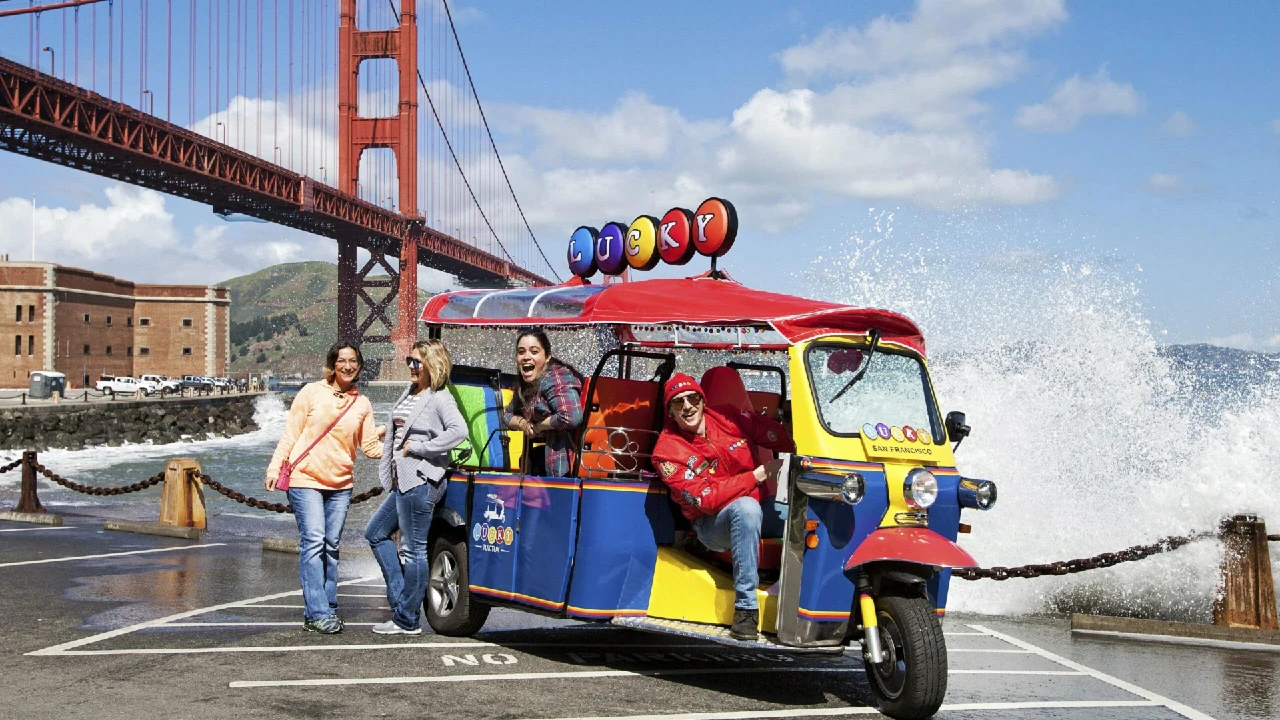
From Fisherman’s Wharf and historic cable cars to Chinatown, North Beach and the city’s classic views, Lucky Tuk Tuk offers private, all-electric sightseeing with a local guide. Ask about the maritime waterfront when choosing your route. Specific stops depend on access, duration and traffic.